Pest guide · Star, Idaho
Boxelder Bugs in Star: Warm Siding, Streamside Trees and the Autumn Gathering
- Reviewed by a licensed Idaho pest professional
When Star’s late-summer heat gives way to cool fall nights, black-and-red boxelder bugs often collect on the sunniest side of a house, garage or barn. They come for warmth and shelter, not for anything inside. A few slip through gaps and spend the winter in wall voids or attics, then show up on windows on bright days. Extension sources treat them as a nuisance, not a danger. The most useful professional work is sealing the openings they use. When clusters are heavy, the exterior surfaces where they gather may also be treated.
Where boxelder bugs turn up around Star
Boxelder bugs feed mainly on the seeds of female boxelder trees. They also use some maples. Boxelder often grows along riverbanks and ditch banks. Homes near the Boise River on Star’s south side, or near the canals and laterals that run through town, may see more of them where those trees grow nearby.
The bugs also favor warm, light-colored walls that face south or west. Older buildings along State Street and established neighborhoods near downtown can have both mature trees and the small cracks that let bugs inside. Farm edges and horse properties with shelterbelts, outbuildings and hay sheds offer more places to cluster.
Newer subdivisions in the northwest farmland and along Highway 16 usually have young landscape trees. Those homes may see fewer boxelder bugs at first, though bugs can fly in from trees nearby. Hot, dry summers and a sharp fall cooldown, typical of the Treasure Valley, help explain why the gathering on house walls is so noticeable here each autumn.
Telling a boxelder bug from other fall visitors
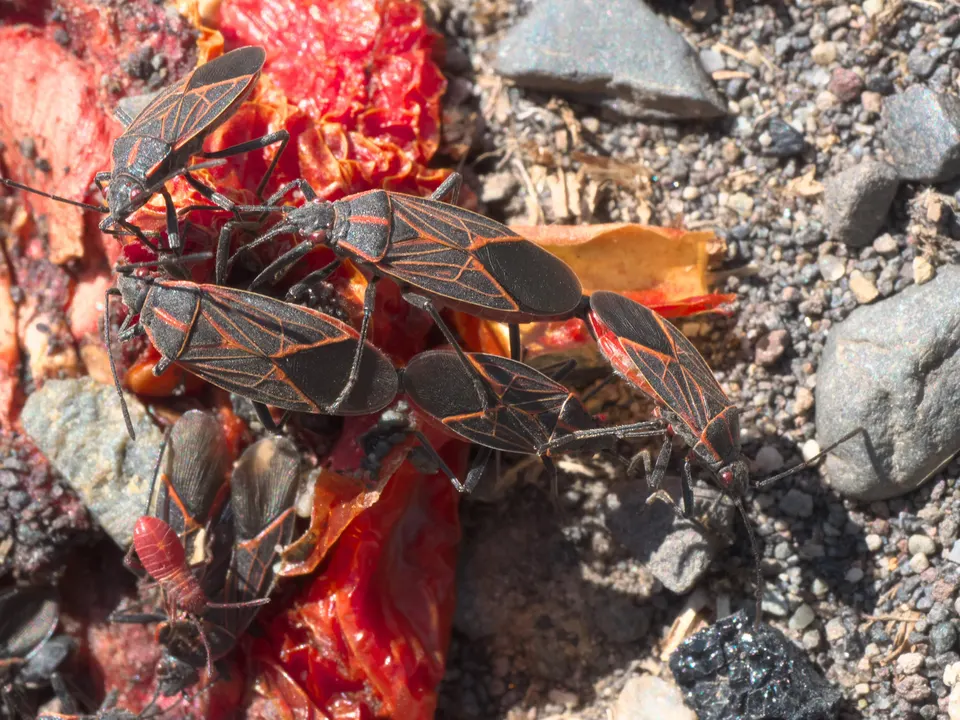
- Adults. About half an inch long, flat-backed and narrow. They are dark gray to black, with red or orange lines along the body edges and on the wings.
- Young bugs. Smaller and wingless, with a lot of bright red. They are often mixed into the same groups as the adults.
- Habits. They crowd together in sunlight on siding, fences, rocks and tree trunks. As the weather cools they crawl into gaps around window frames, vents, trim and foundations. On warm winter days, some wake up and wander indoors toward the light.
- Concerns. They do not damage framing, furniture or stored food. Indoors, the main problems are the numbers, a musty smell when they are crushed, and small spots their droppings can leave on curtains or pale walls.
University of Idaho Extension and the Pacific Northwest Insect Management Handbook both describe the autumn move into buildings as the real household issue. They do not describe feeding damage inside rooms.
Signs it is time to bring in a professional
- Bugs gather on the same walls of your Star home every fall, year after year.
- You find them in attics, upstairs rooms or light fixtures, not just outside.
- Many bugs appear on sunny windows during winter, which suggests they are spending the cold months inside the walls.
- Droppings leave spots on window coverings, light siding or trim.
Late summer is the best time to ask for a free quote, before the fall gathering begins. Once the bugs have settled inside the structure, it is harder to seal every gap.
What licensed boxelder bug work usually looks like
The handbook is direct on this point. Insecticide use inside a house does little good and is not advised there. Residual work by a pest control operator on outside walls and near the foundation can reduce how many bugs get in, but it will not remove them all. For that reason, a licensed provider usually combines several steps:
- An inspection of the building shell. This means checking window and door frames, siding seams, soffits, corner boards, attic and gable vents, and screens for tears.
- Exclusion. Closing gaps with caulk or sealant, fixing damaged screens, and adding fine screening over eave and attic vents. University of Idaho Extension recommends that screening. The handbook notes that this work is best done during the warm months, before the bugs arrive.
- Targeted exterior treatment. When a large group is active, the provider may treat the sunny walls and foundation areas where the bugs gather. Interior rooms are left out.
For more on timing, see the seasonal pest calendar. For help choosing a company, read how to choose a pest control company in Idaho.
Request a free quote for boxelder bugs in Star
Recommended local provider
This guide recommends ProGuard, a local, family and veteran owned company. Its treatments are family and pet safe. Describe what you are seeing and request a free quote. Requests are passed to a licensed local provider.
- Local, family and veteran owned
- Licensed and insured
- Family and pet safe
- Free quote
- Serves Star, Idaho
Your request is shared with a licensed local provider, so they can reply. This guide does not sell your information.
Boxelder bug questions from Star homeowners
We live near the river. Is that why we see so many?
It can be. Boxelder trees often grow along rivers and ditch banks, and the bugs feed on their seeds. A home close to those trees, with a sunny wall, is an easy fall stop for them. Homes farther from mature trees tend to see fewer.
Our house in a newer subdivision just got its first batch. Why now?
Young landscape trees produce few seeds, but boxelder bugs fly well. They can come in from nearby trees, field edges or older properties. The number usually depends on the trees within flying distance and how many gaps your house has.
Can they hurt my kids, pets or horses?
Extension sources call boxelder bugs a nuisance, not a health or structural pest. The main complaints are crowds of bugs, a smell when they are crushed, and spotting on light surfaces.
Someone came to my door offering fall bug service. How do I know they are legitimate?
In Star, door-to-door salespeople, including pest control sellers, need a solicitor permit from the City Clerk. They must also wear a city-issued photo badge while they work. You can ask to see the badge and check the city’s list of approved solicitors. Under the city code and the federal Cooling-Off Rule, many door-to-door sales can be canceled within three business days.
Sources
- University of Idaho Extension
- Pacific Northwest Insect Management Handbook
- National Weather Service, Local Climate of the Treasure Valley
- City of Star, Approved Vendors and Door-to-Door Solicitors
- City of Star, Vendor and Special Event Permits
- Star City Code (Municode)
- FTC Cooling-Off Rule, 16 CFR Part 429
Each citation links to the university, agency or city record behind the fact.
More Star pest guides: browse all pests or see the Star neighborhoods guide.
More pests that show up around Star homes
Need help with a pest in Star?
Describe what you are seeing and request a free quote. Requests are passed to a licensed local provider.